Dyson Hot Cool Air Purifier Review 2026: Worth the Price?
Cold mornings, dusty afternoons, and pollen heavy evenings all hit the same room in your home. Most people buy three machines to handle that. A heater for January. A fan for July. A purifier for allergy season. The Dyson Purifier Hot+Cool HP07 promises to replace all three with one bladeless tower that sits quietly in the corner.
That promise carries a heavy price tag. The HP07 still lists near $749 in 2026, and replacement filters cost roughly $80 each year. So the real question is simple. Does this machine earn its keep, or are you paying for the Dyson logo?
This review covers purification power, heating speed, noise, app control, running costs, and the situations where a cheaper machine makes more sense.
Read on for a clear verdict, honest downsides, and three strong alternatives if the HP07 stretches your budget too far.
Key Takeaways
- The HP07 works as three appliances in one. It purifies air all year, heats a full room in winter, and cools you with a strong stream of air in summer. That flexibility justifies part of the high cost, especially in small homes with limited floor space.
- Filtration quality is excellent, but airflow volume is modest. The sealed HEPA H13 and activated carbon filter captures 99.97% of particles down to 0.3 microns. Clean air delivery sits near 87 cubic metres per hour, which suits bedrooms and offices better than large open plan spaces.
- Automatic mode does the thinking for you. Onboard sensors track particles, gases, temperature, and humidity, then adjust fan speed without any input. The LCD screen and MyDyson app show live readings in plain language.
- Noise is low on settings 1 to 4 and loud at maximum. Quiet settings measure around 30 decibels, while full power reaches roughly 62 decibels. Light sleepers should stick to night mode, which dims the display and caps the speed.
- Running costs add up over time. Budget around $80 every twelve months for the combined filter, plus heating electricity during cold months. The heater draws up to 1500 watts, similar to any standard space heater.
- Cheaper rivals now match parts of the formula. Shark, Dreo, and the Dyson HP10 Gen1 all cost far less. You pay Dyson prices for design, app depth, sensor accuracy, and the 350 degree oscillation.
Dyson Purifier Hot+Cool HP07 Overview

- Automatically senses, captures, and traps pollutants for cleaner air.
- Multifunctional. Intelligently purifies, heats, and cools you.²
Last update on 2026-11-01 / Affiliate links / Images from Amazon Product Advertising API
The HP07 sits in the middle of the Dyson air treatment line. It arrived as the successor to the older HP04 and brought a fully sealed filter system to the family.
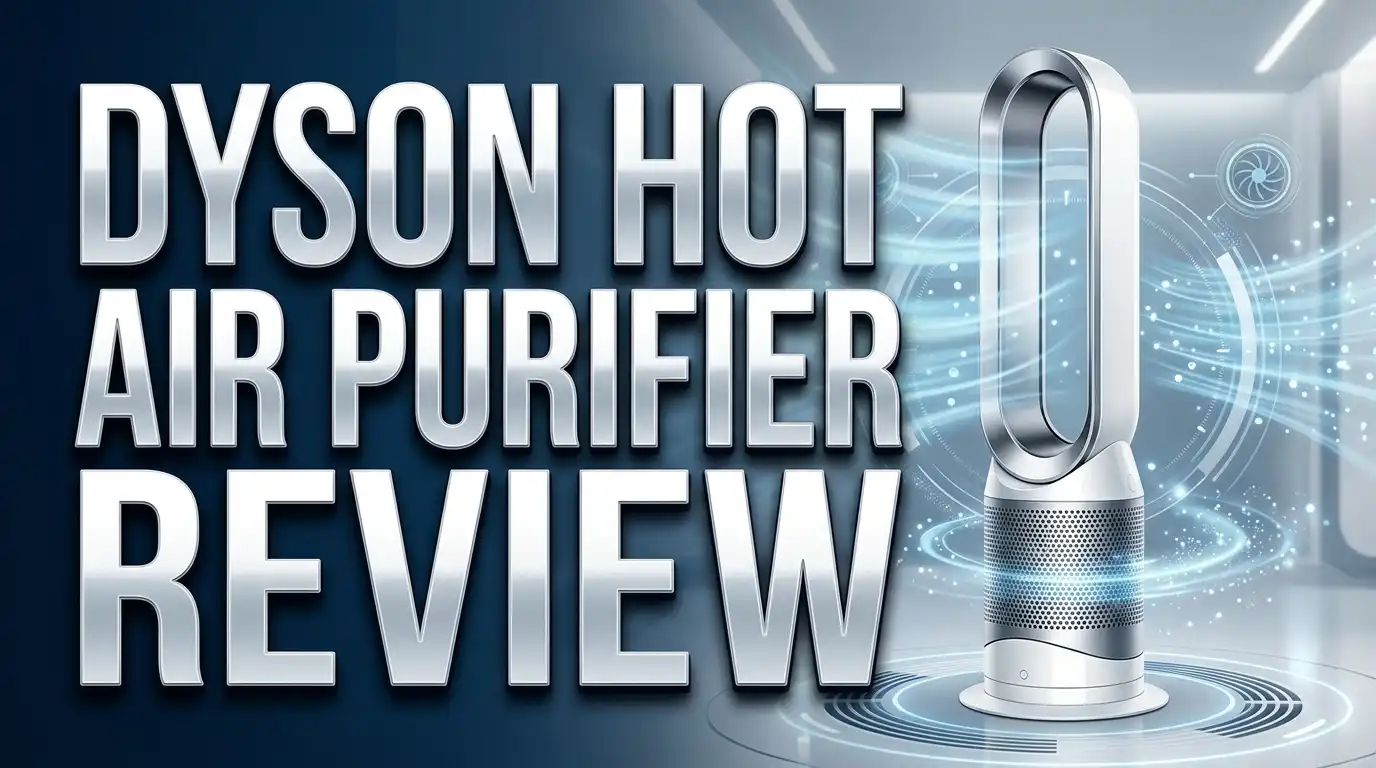
Dyson calls it a purifying fan heater. In plain terms, it pulls room air through a filter ring, then pushes clean air back out through a hollow loop at the top.
The bladeless design is the part everyone notices first. No exposed fan blades spin inside the loop, which makes the machine safer around toddlers and curious pets.
The tower stands about 30 inches tall and weighs close to 13 pounds. A carry handle sits in the middle, so moving it between rooms takes seconds.
Three jobs run from one body. Purification runs all year. Heating uses ceramic plates rated to 1500 watts. Cooling uses Air Multiplier technology to project a long stream of air across the room.
You control everything through a small magnetic remote, the LCD panel, the MyDyson app, or a voice assistant such as Alexa or Siri.
Dyson rates whole room purification for spaces up to 800 square feet using the POLAR test method. Real world results depend on ceiling height, door position, and how hard you run the fan.
For anyone in a studio apartment, a nursery, or a home office, the all in one approach removes clutter. That practical benefit matters more than any spec sheet number.
What You Get Inside the Box
Dyson keeps packaging simple and mostly plastic free, which fits their sustainability messaging in 2026.
Open the box and you find the main tower already assembled. The base and loop arrive as one piece, so no tools are needed.
The combined HEPA H13 and activated carbon filter comes preinstalled. You only remove two plastic wrappers before first use.
A small curved remote sits in a recess at the top. It clips magnetically to the loop, which stops it from vanishing under the sofa.
The quick start guide runs a few pages and covers filter reset, WiFi pairing, and cleaning. Most owners finish setup in under ten minutes.
One nice touch is the machine prompting you to download the MyDyson app during first startup. The app then walks you through connection with clear steps.
Nothing else ships in the standard box. There is no spare filter, no cover, and no cleaning brush.
Some Amazon bundles include an extra filter set, which saves money if you plan to keep the machine for several years.
Check the model code on the label before you buy. Retailers list the HP07 under several colour options such as white and silver, black and nickel, and the gold edition.
The colour changes nothing about performance. It only changes price and shelf appeal.
Design and Build Quality
The HP07 looks like a product from a design museum rather than an appliance aisle. That styling is a genuine part of the value.
Panels feel solid, the finish resists fingerprints, and the base rotates smoothly without wobble.
The 350 degree oscillation is the standout mechanical feature. The loop turns almost a full circle, which spreads air far wider than the 70 degree sweep on most tower fans.
You can also tilt the loop forward and back by hand. That helps direct heat at your feet or push cool air across a bed.
The LCD screen sits low on the front. It cycles through particle levels, gas levels, temperature, humidity, and filter life.
Reading the screen from across a room is harder than it looks in marketing photos. The text is small, so most people rely on the app instead.
Cleaning stays easy. Wipe the loop with a dry cloth and vacuum dust from the inlet mesh every few weeks.
The filter unlocks with two side buttons and slides off in one motion. No screws, no fiddling, no tools.
Build quality holds up well over years of use, based on long term owner reports. The most common complaint is a small rattle from the oscillation motor on older units.
Air Purification Performance
Filtration is where the HP07 earns real respect. Dyson seals the whole airflow path to HEPA H13 standard, so air cannot leak around the filter.
The filter captures 99.97% of particles as small as 0.3 microns. That covers pollen, dust, mould spores, pet dander, and wildfire smoke particles.
An activated carbon layer sits behind the HEPA media. It absorbs odours, cooking smells, and volatile organic compounds from paint or cleaning sprays.
Independent testing shows the HP07 removing smoke and dust effectively in rooms up to about 300 square feet. Larger rooms take longer because airflow volume is moderate.
Clean air delivery measures around 87 cubic metres per hour on lab tests. Several cheaper box style purifiers push more air for less money.
So why does the HP07 still perform well in daily use? Oscillation and airflow projection matter as much as raw volume. The machine circulates air across the whole room instead of only cleaning the pocket beside it.
Sensors deserve praise too. A laser particle sensor tracks PM2.5 and PM10, while a separate sensor detects gases.
Auto mode raises fan speed when it detects cooking, vacuuming, or a spike in pollen. It drops back to a whisper once readings settle.
The result feels genuinely automatic. You stop thinking about air quality, which is exactly the point.
Top 3 Alternative for Dyson Purifier Hot+Cool HP07
Not everyone wants to spend $749 on one appliance. These three alternatives cover different budgets and priorities while keeping the heat, cool, and purify formula intact.

- Air Multiplier technology circulates purified air throughout the whole room.¹
Last update on 2026-11-01 / Affiliate links / Images from Amazon Product Advertising API

Last update on 2026-11-01 / Affiliate links / Images from Amazon Product Advertising API

- Wind Speeds Faster Than Ever: The 1800 RPM upgraded DC motor delivers an extra boost in performance, blowing 1585 CFM of...
- The Ultimate Fan & Heater: the DREO MC706 integrates an auto-shift tech that lets you go from a 5-level 1500W PTC room...

Last update on 2026-11-01 / Affiliate links / Images from Amazon Product Advertising API
The Dyson Purifier Hot+Cool Gen1 HP10 is the smart pick if you want the Dyson experience for less. It uses the same sealed HEPA H13 filtration and the same three functions, but drops the price to around $530 to $630.
You lose some sensor detail and a little airflow reach. For a bedroom or study, most people never notice the difference.
The Shark 3 in 1 Air Purifier, Heater and Fan brings NanoSeal HEPA filtration and Cleansense IQ automatic sensing at a much friendlier price. It covers around 500 square feet and captures 99.98% of tested particles.
Shark leans into practical power rather than sculptural design. Owners praise the strong heat output and the odour control feature.
The Dreo Tower Fan and Heater Combo targets buyers who mainly want climate comfort with clean airflow. A powerful DC motor moves air up to 40 feet, and heating arrives fast.
Dreo pricing usually lands under $200, which makes it the value option for spare rooms, garages, and offices.
Heating Performance in Winter
The HP07 heats through ceramic plates, then uses Air Multiplier technology to project warm air across the room.
Maximum power reaches 1500 watts, which matches almost every plug in space heater sold in the United States.
You set a target temperature between 33 and 99 degrees Fahrenheit. The machine heats until the room reaches that number, then switches off the element and keeps monitoring.
This thermostat behaviour saves electricity compared with heaters that run constantly.
Heat spreads well thanks to oscillation. Instead of roasting one side of your body, the loop sweeps warmth across a wide arc.
Warm up speed feels moderate rather than instant. A small bedroom warms in about ten to fifteen minutes, while a large lounge takes longer.
Two safety features make this a good family choice. The machine cuts power automatically if it tips over, and no hot exposed element sits within reach.
Purification keeps running while heating runs. That matters in winter, when closed windows trap indoor pollutants.
One point deserves honesty. A $60 ceramic heater produces the same heat for far less money.
You are buying the combination, the safety design, and the automatic control. If heating is your only need, buy a dedicated heater instead.
Cooling Performance in Summer
Cooling works through pure airflow, not refrigeration. The HP07 does not lower room temperature the way an air conditioner does.
What it does deliver is a long, smooth stream of air that reaches across a room.
Ten fan speeds give fine control. Setting 1 barely stirs the curtains. Setting 10 produces a strong breeze you feel from several metres away.
Air Multiplier technology draws in surrounding air and amplifies the output, which is why the stream feels wider than the loop opening suggests.
Combine cooling with 350 degree oscillation and one machine can serve two people sitting on opposite sides of a room.
Diffused mode is worth knowing about. It sends purified air out of the back of the machine instead of the front.
That setting cleans the air without blowing on you, which helps in winter or when someone dislikes direct airflow.
Cooling airflow drops slightly compared with dedicated tower fans, because air must pass through a dense HEPA filter first. Filtration always costs some airflow.
For most bedrooms and offices, output feels more than enough. In a hot climate with no air conditioning, you will still want a stronger fan.
Noise Levels and Sleep Use
Noise decides whether an air purifier lives in your bedroom or your hallway.
The HP07 performs well at low settings. Speeds 1 to 4 sit near 30 to 40 decibels, which reads as soft white noise.
Maximum speed climbs to roughly 62 decibels. That is loud enough to interfere with television or conversation.
Auto mode usually parks the machine at low speed once air quality is good, so the loud settings rarely appear at night.
Night mode is the feature light sleepers should use. It dims the display to the lowest brightness and limits fan speed while sensors keep working.
Owners repeatedly describe the low speed sound as pleasant rather than intrusive. The tone is smooth, without the motor whine some cheap purifiers produce.
Heating adds a faint click when the ceramic element cycles on. Most people never notice it.
Oscillation is silent on newer units. Older machines sometimes develop a light mechanical tick as the base wears.
A simple sleep routine works well. Run speed 7 or higher for twenty minutes before bed, then switch to night mode.
That approach cleans the room quickly, then keeps things quiet while you sleep.
Smart Features and the MyDyson App
The MyDyson app turns a good machine into a genuinely smart one.
Pairing takes a couple of minutes over WiFi. After that, you control the HP07 from anywhere.
Live air quality graphs are the best part. You see particle and gas levels across the last twelve hours, days, weeks, and months.
Those graphs teach you things. Frying food spikes particles instantly. A new rug can raise gas readings for days.
Understanding your own air makes the machine feel worthwhile beyond the specs.
Scheduling works well too. Set the heater to warm your office before you arrive, or set the purifier to run during pollen heavy mornings.
Filter life appears as a simple percentage. The app sends a notification when replacement time approaches.
Voice control works with Amazon Alexa, Siri, and Google Assistant. Commands cover power, fan speed, temperature, and mode.
The physical remote handles everything without a phone. It magnetically parks on top of the loop, which is a small but clever detail.
Some owners report occasional connection drops after router changes. Reconnecting takes under a minute.
No subscription is needed for any app feature. Everything included stays free for the life of the machine.
Filter Life and Replacement Costs
Ownership cost matters more than the sticker price over five years.
The HP07 uses one combined filter that holds both the HEPA H13 glass media and the activated carbon layer.
Dyson recommends replacement every twelve months based on twelve hours of daily use.
A genuine replacement filter costs roughly $70 to $80 in 2026. Prices shift with retailer promotions.
Heavy use shortens filter life. Homes with pets, smokers, or wildfire smoke exposure often need a new filter sooner.
The machine tracks usage hours rather than guessing. When life drops to zero, the screen displays a replacement prompt.
Swapping the filter takes about thirty seconds. Press the two side buttons, lift the shroud, remove the old filter, and drop in the new one.
You must reset the counter afterwards by holding the remote power button for six seconds. Skip this step and the reminder keeps appearing.
Third party filters exist and cost less. They often reduce filtration quality and can void warranty support, so most owners stick with genuine parts.
Add the yearly filter to the purchase price and the true five year cost lands near $1100. Factor that in before you buy.
Energy Use and Running Costs
Electricity use splits into two very different numbers.
As a purifier and fan, the HP07 sips power. Low speeds draw roughly 6 to 40 watts, which costs pennies per day.
As a heater, it draws up to 1500 watts. That is where bills grow.
Running the heater for four hours daily through winter can add a noticeable amount to a monthly bill, depending on local rates.
The thermostat helps a lot. Once the room reaches your target temperature, the element switches off and only the fan continues.
Setting a realistic temperature such as 68 degrees Fahrenheit saves far more money than any efficiency setting.
Auto mode helps on the purification side. The fan stays low when air quality is good instead of running at full speed constantly.
Sleep timers prevent overnight waste. You can set the machine to shut down after 30 minutes up to 8 hours.
Compare this to running a separate heater, fan, and purifier at once. One machine usually draws less total power than three.
For a fair comparison, treat the heating cost as identical to any 1500 watt space heater. The purification cost is small by comparison.
Pros and Cons
Every expensive appliance carries trade offs. Here is the honest balance sheet after reviewing performance data and owner feedback.
Pros
- Fully sealed HEPA H13 and carbon filtration captures 99.97% of particles down to 0.3 microns, including pollen, smoke, and pet dander.
- Genuine three in one function replaces a heater, a fan, and a purifier, which saves floor space in small homes and apartments.
- The 350 degree oscillation spreads clean air, heat, or cooling across an entire room instead of one narrow strip.
- Bladeless design removes the safety risk of exposed spinning blades, making it a strong choice for homes with children or pets.
- The MyDyson app delivers detailed air quality history, scheduling, filter tracking, and voice assistant support at no extra cost.
- Automatic mode adjusts speed using accurate particle and gas sensors, so the machine manages itself day to day.
- Build quality feels premium, and the single filter swaps out in seconds with no tools required.
Cons
- The purchase price near $749 sits far above rivals that deliver similar filtration performance for a fraction of the cost.
- Clean air delivery is modest, so very large open plan rooms clean more slowly than the 800 square foot claim suggests.
- Maximum fan speed reaches around 62 decibels, which is too loud for sleeping or watching television.
- Yearly filter replacement adds roughly $80 to running costs, and third party filters carry quality risks.
- The heater draws 1500 watts, so winter electricity costs match any standard space heater.
- The small LCD screen is difficult to read from across a room without using the app.
Who Should Buy the Dyson HP07
The HP07 suits specific buyers extremely well and disappoints others.
Apartment dwellers gain the most. One machine replaces three, which frees floor space and removes seasonal storage headaches.
Allergy sufferers benefit from the sealed filtration and accurate sensors. Many owners report fewer morning symptoms after a few weeks of nightly use.
Parents of young children appreciate the bladeless safety design and the automatic tip over shutoff.
People who love data will enjoy the app. Watching particle graphs respond to cooking or cleaning becomes oddly addictive.
Design conscious buyers get a machine that looks intentional in a living room, not hidden in a corner.
Now the other side. Anyone who only needs air purification should buy a dedicated purifier. Cheaper models from Levoit, Winix, or Coway move more air for far less money.
Anyone in a hot climate without air conditioning will find the cooling underpowered compared with a big tower fan.
Owners of large open plan homes should look at bigger capacity machines or run two units.
Budget shoppers should compare the Dyson HP10 Gen1 first. It keeps the core experience and cuts several hundred dollars from the price.
Price and Value in 2026
The HP07 launched at a premium price and holds most of that value years later.
List price still sits around $749 through Dyson directly. Amazon and other retailers regularly discount it to the $500 to $650 range.
Refurbished units appear through Dyson outlet channels for less, often with a shorter warranty.
Value depends entirely on how many functions you actually use. Buy it as a purifier alone and it looks overpriced.
Buy it as a heater, fan, and purifier in one, and the maths improves quickly. Three quality appliances would cost a similar amount and take three times the space.
The two year warranty on parts and labour adds confidence. Dyson customer service generally receives solid marks for honouring it.
Resale value stays surprisingly strong. Used HP07 units frequently sell for more than half their original price.
Watch for seasonal deals. Prices usually drop during autumn heating promotions and spring allergy campaigns.
Never buy at full list price if you can wait. Discounts appear several times each year.
If your budget stops below $400, the Shark or Dreo alternatives make far more sense than stretching for this model.
Final Verdict
The Dyson Purifier Hot+Cool HP07 remains one of the most complete home air machines you can buy in 2026.
Filtration quality is excellent, sensors are accurate, the app is genuinely useful, and the three in one design saves real space.
The weaknesses are price and airflow volume, not capability. Cheaper purifiers move more air, and cheaper heaters produce the same warmth.
What no cheaper machine matches is the whole package. Sealed HEPA filtration, 350 degree oscillation, thermostatic heating, and detailed air data in one elegant tower.
Buy it if you value simplicity, design, and year round comfort in a small or medium room. Skip it if you need maximum clean air per dollar in a large space.
For most buyers, the Dyson HP10 Gen1 offers the smarter balance of price and performance. For buyers who want the flagship experience, the HP07 still delivers.
Frequently Asked Questions
Does the Dyson HP07 actually cool a room?
No. The HP07 moves air rather than chilling it. You feel cooler because moving air speeds evaporation from your skin. Room temperature stays the same. It is a powerful fan, not an air conditioner.
How often should I change the HP07 filter?
Dyson recommends every twelve months at twelve hours of daily use. Heavy pollution, pets, or smoke shorten that window. The machine tracks hours and displays a prompt when replacement time arrives.
Is the Dyson HP07 loud at night?
Low settings measure around 30 to 40 decibels, which most people find soothing. Night mode dims the screen and limits speed. Only the top fan speeds become distracting.
Can the HP07 heat a large living room?
It heats effectively in rooms up to roughly 300 to 400 square feet. Larger rooms warm slowly. For open plan spaces, expect supplementary heat rather than a full replacement for central heating.
Does the HP07 remove formaldehyde?
No. Formaldehyde detection and destruction is the feature of the HP09 model. The HP07 captures particles and many gases through its carbon layer, but it does not specifically monitor formaldehyde.
Is the HP07 worth it compared with the HP10 Gen1?
The HP07 adds better sensors, wider oscillation reach, and stronger airflow. The HP10 costs several hundred dollars less with the same core filtration. For bedrooms, the HP10 is the better value.
Can I use third party filters in the HP07?
You can, and they cost less. Filtration quality and sealing often fall short of genuine parts, and warranty support may be affected. Most long term owners stick with official Dyson filters.

Hi, I’m Nezuko, the founder and chief reviewer behind HomeReviewed.blog. As a passionate home technology enthusiast with years of experience testing and reviewing home products, I’m committed to helping you navigate the world of modern home gadgets. I personally test every product I review, ensuring you get authentic, real-world insights to guide your purchasing decisions.