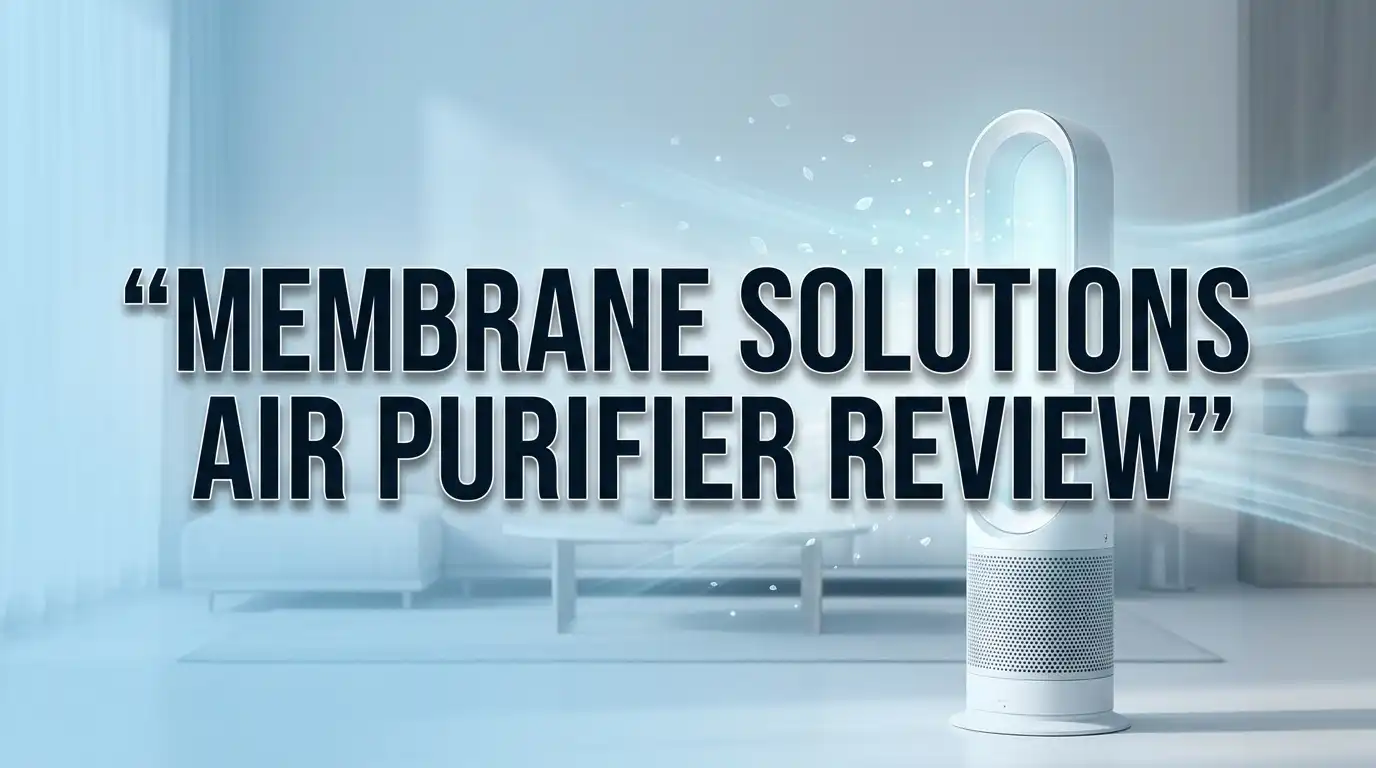
Membrane Solutions Air Purifier Review 2026: Worth The Price?
Clean air at home should not cost a fortune. That simple idea is what pushes many shoppers toward Membrane Solutions, a brand that sells budget friendly HEPA units with big coverage claims printed on the box.
But do those claims hold up in a real bedroom with real dust, real pet hair, and a real electricity bill? That question deserves a straight answer.
This review breaks down the Membrane Solutions air purifier lineup in plain language. You get tested numbers, honest weak spots, filter costs, and three strong alternatives if this brand is not the right fit.
I focus mainly on the MSA3, the flagship model most buyers see first, plus the smart MSA3S version. By the end, you will know if this purifier belongs in your home or in someone else’s cart.
Key Takeaways
- The MSA3 cleans small rooms very well. Independent testing showed a 92 percent air quality improvement in a 194 square foot room after 60 minutes on high speed. In a larger 320 square foot room, it still reached 89 percent.
- The coverage claim is optimistic. Membrane Solutions advertises up to 1590 square feet, but that figure uses a very low air change rate. For proper cleaning at 4.8 air changes per hour, treat this unit as a 175 square foot purifier.
- It is genuinely quiet. The MSA3 measured 43.1 dBA on low and 54.3 dBA on high, placing it among the quietest units in its class. Bedroom use is comfortable.
- Odor removal is the weak point. The carbon layer is thin, so heavy cooking smells, smoke odor, and litter box smells fade slowly compared to purifiers with thicker carbon.
- Running costs sit slightly above average. The 44W motor costs roughly $3.44 per month at full speed, and filters last 3 to 6 months, so budget for replacements.
- The MSA3S adds smart features. Wifi, app control, Alexa support, an air quality sensor, and auto mode come with the S version for a higher price.
Membrane Solutions MSA3 Air Purifier Review at a Glance

- NOTE: Please order Membrane Solutions Genuine MSA3 Air Filters, search on amazon: B08FSZFFCY&B09VGYK54J. Non-Official...
- Powerful Performance: MSA3 air purifier for home large room captures 99.97% of fine airborne particles including pet...
Last update on 2026-11-01 / Affiliate links / Images from Amazon Product Advertising API
The MSA3 is the model that put this brand on the map. It is a tall white tower with a front loading filter and touch buttons near the top.
The unit measures 7.7 by 13.1 by 21.5 inches and weighs about 13.6 pounds. That size fits beside a nightstand, behind a sofa, or next to a desk without blocking a walkway.
Filtration runs in three stages: a pre filter for hair and lint, an H13 true HEPA layer for fine particles, and an activated carbon layer for odors. All three sit inside one cartridge, so replacement takes about two minutes.
The claimed Clean Air Delivery Rate is 112 CFM, or 190 cubic meters per hour. That number is honest and matches what testers recorded.
Airflow enters through the front and sides, then exits through vents at the top. This upward pattern spreads clean air across the room instead of blowing it at a wall.
You get three fan speeds. The Turbo button simply jumps to speed three, and the Sleep button drops to speed one, so the control panel looks busier than it really is.
The unit is CARB certified and produces zero ozone. There is no ionizer and no UV lamp, which is good news for anyone with asthma.
Extra touches include a filter change indicator, a 1 to 8 hour timer, a child lock, and a light dimming button. Membrane Solutions backs the purifier with a two year warranty when you register the product.
What You Get Inside the Box
Unboxing takes under five minutes. The packaging uses reinforced cardboard, which helps the tower survive shipping without dents.
Inside you find the MSA3 air purifier, one preinstalled 3 in 1 filter, and a printed user manual. That is the whole kit.
One step matters more than any other: remove the filter and strip off the plastic wrapper before first use. Many buyers skip this and then complain that the purifier does nothing.
A wrapped filter blocks airflow completely. The motor works harder, heat builds inside the housing, and the unit can fail early.
Opening the front cover takes a firm pull on the bottom tab. The cover fits tightly, so do not worry if it feels stiff on the first try.
The power cord is long, which gives you freedom in room layout. Many purifiers ship with short cords that force awkward placement near an outlet.
There is a molded handle slot on the top rear of the unit. It makes carrying the purifier between the bedroom and living room easy for one person.
No remote control comes in the box, and the standard MSA3 has no app. Every setting happens through the touch panel on the front.
The white finish is smooth and glossy, so fingerprints show up quickly. A dry microfiber cloth wipes them away in seconds.
Overall the unboxing feels appropriate for the price. Nothing feels luxurious, but nothing feels flimsy either.
Design, Build Quality, and Controls
The MSA3 looks modern without shouting for attention. The plain white tower blends with most furniture styles, from a wood dresser to a glass desk.
Build quality is solid for a budget purifier. The plastic is thick enough to resist flexing, though the glossy surface reads a little cheap under bright light.
Touch controls sit in two horizontal strips on the front face, and blue indicator lights glow beneath each button. The blue tone is a nice change from the usual white and orange lights.
Button response is quick and accurate. One tap registers every time, which is not true of every touch panel in this price range.
The layout does create some confusion. Button icons blend into the white surface, so finding the timer at night takes a moment.
The light button dims the indicators, but one small light above that button stays on. Light sensitive sleepers may want to cover it with a small piece of tape.
Filter access is the one design flaw worth flagging. The front cover needs a firm tug, and the filter sits at an angle that requires care during removal.
The child lock deserves praise. Hold the lock button for three seconds and every other control freezes, which keeps curious toddlers from switching modes.
One more quirk: the MSA3 does not remember your last setting. Every power cycle starts the fan back at speed one.
Top 3 Alternatives for Membrane Solutions Air Purifier

- WHY CHOOSE AHAM VERIFIDE AIR PURIFIERS: AHAM (Association of Home Appliance Manufacturers) is an ANSI-accredited...
- HIGH-PERFORMANCE AIR PURIFICATION: A powerful 56W high-torque motor and 143 CFM CADR delivers fast, effective cleaning...

Last update on 2026-11-01 / Affiliate links / Images from Amazon Product Advertising API

- [Coverage] Designed to clean spaces up to 1,748 sq. ft. in 60 minutes
- [Four Stage Filtration System] Combination of a washable pre-filter, deodorization filter, Bipolar Device, and HEPA...
Last update on 2026-11-01 / Affiliate links / Images from Amazon Product Advertising API

- 𝐀𝐇𝐀𝐌 𝐕𝐞𝐫𝐢𝐟𝐢𝐝𝐞 𝐚𝐭 𝟑92 𝐬𝐪 𝐟𝐭.: Also cleans rooms up to 1,882 sq...
- 𝐖𝐢𝐧𝐢𝐱 𝐓𝐫𝐮𝐞 𝐇𝐄𝐏𝐀: Captures 99.99%* of airborne allergens including pollen, dust...
Last update on 2026-11-01 / Affiliate links / Images from Amazon Product Advertising API
Each alternative costs a bit more than the base MSA3. The extra spend buys either better odor control or true automation, so weigh what matters most in your home.
The Three Stage Filtration System Explained
Filtration decides everything. A purifier is only as good as the media inside it, so this section matters more than any feature list.
Stage one is the pre filter. This mesh layer traps hair, pet dander clumps, and carpet fibers before they reach the finer media behind it.
A clean pre filter extends the life of the HEPA layer, which saves you money. Vacuum it once a month with a brush attachment.
Stage two is the H13 true HEPA filter. It captures 99.97 percent of particles down to 0.3 microns, which covers pollen, dust mite debris, mold spores, and fine smoke particles.
This is the layer allergy sufferers care about. Ragweed pollen, cat dander, and dust all fall well within its capture range.
Stage three is activated carbon. Carbon works through adsorption, meaning gas molecules stick to the porous surface of the pellets.
Here is the honest problem: the MSA3 uses a light carbon load, spread thinly across the sheet. Testers found gas removal slow, and heavy odors linger far longer than particles do.
If your main goal is dust, pollen, or pet hair, the filtration package works well. If your main goal is kitchen smells or cigarette odor, look at a unit with a thicker carbon block.
None of these filters are washable. Water destroys HEPA media and ruins carbon capacity, so never rinse the cartridge.
Real Performance Test Results in Different Room Sizes
Numbers beat marketing copy. Independent testing with a laser particle meter gives a clear picture of what this purifier actually does.
In a 194 square foot room, the MSA3 ran at maximum speed for 60 minutes. PM2.5 dropped from 99.6 to 7.1 micrograms per cubic meter.
That is a 92 percent improvement in air quality. The AQI reading fell from 130 down to 10, which moves the room from unhealthy into clean territory.
In a larger 320 square foot room, the same test produced an 89 percent improvement. PM2.5 fell from 97.5 to 10.3 micrograms per cubic meter.
Both results are strong for a purifier in this price band. The unit clearly moves enough air to make a measurable difference.
The smoke box test told a similar story. The MSA3 cleared a sealed glass box of visible smoke in about 30 seconds, which is a respectable mid pack result.
The catch is sustained coverage. At 4.8 air changes per hour, the recommended standard for allergy relief, the MSA3 properly covers about 175 square feet.
The advertised 1590 square feet assumes roughly one air change per hour. Air technically passes through the filter at that size, but not often enough to control allergens.
My practical advice: use this purifier in bedrooms, offices, and small living rooms. Buy two units if you want coverage across a large open floor plan.
Noise Levels and Bedroom Use
Noise ruins more air purifiers than poor filtration does. A machine you switch off at bedtime cleans nothing.
The MSA3 performs very well here. Measured output was 43.1 dBA on speed one, 47.4 dBA on speed two, and 54.3 dBA on speed three.
Speed one is quiet enough for light sleepers. The sound reads as soft white noise rather than a mechanical hum.
Speed three stays under 55 dBA, which is unusually quiet for full power. Many competitors cross 60 dBA at their top setting.
The motor runs smoothly with no rattling, clicking, or pulsing. That matters, because irregular noise annoys people far more than steady noise at the same volume.
One reported issue deserves mention. A handful of long term owners have described a fan squeak after a year or more of daily use.
A drop of light machine oil on the fan bearing usually solves it, though that fix voids the appeal of a maintenance free appliance. Contact support first if your unit is still under warranty.
The Sleep button drops the fan to speed one and dims the display. Combined with the light control button, the front panel goes almost fully dark.
For nursery use, the low speed setting works well overnight. For a dusty living room, run high during the day and drop to low in the evening.
Membrane Solutions MSA3S Smart Air Purifier

- Note: To utilize App control, ensure the device is powered on within the home's 2.4GHz WiFi network. If the device...
- Alexa & APP Control: With Amazon Alexa, you can control MSA3S smart air purifier with your voice. Free your hands when...
Last update on 2026-11-01 / Affiliate links / Images from Amazon Product Advertising API
The MSA3S is the upgraded twin of the MSA3. Same body, same filter, same 112 CFM airflow, but with a brain added.
The headline addition is a laser particle sensor paired with a color coded air quality indicator. Blue means clean, and the light shifts through orange and red as particle levels rise.
That sensor unlocks auto mode, the feature most worth paying for. The purifier raises fan speed when cooking smoke appears and drops back down once the air clears.
Wifi connectivity comes standard. The companion app lets you change speeds, set schedules, check filter life, and view air quality readings from your phone.
Voice control works through Amazon Alexa. Saying a simple command to raise the fan speed feels genuinely useful when your hands are full.
Cleaning performance stays the same as the base model. You are paying for automation and convenience, not for stronger filtration.
Filter cartridges are shared between the MSA3 and MSA3S, which simplifies reordering if you own both units.
Is the upgrade worth it? If you plan to run the purifier constantly at one speed, save your money and buy the standard MSA3.
If you want the machine to manage itself while you work or sleep, auto mode earns the price difference. Set it and forget it is a real benefit over months of ownership.
Running Costs, Filter Life, and Long Term Value
Purchase price tells only half the story. Filters and electricity determine what the purifier truly costs over three years.
The MSA3 draws 27W on low, 30.6W on medium, and 39.2W on high, with a 44W rated motor. Standby draw is a negligible 0.2W.
Running the unit 24 hours a day at full speed adds roughly $3.44 per month to an electricity bill at 12 cents per kWh. Low speed costs about $2.37 per month.
Those figures are fine in absolute terms. Compared to rivals with the same CADR, though, the MSA3 sits on the thirsty side.
Filters last about 2000 hours, which works out to 3 to 6 months of regular use. Heavy dust, pets, or wildfire season shorten that window.
Genuine replacement cartridges cost more than filters for several competing brands. Multipack listings and third party options exist, though third party media quality varies.
The filter reset indicator removes the guesswork. A light above the reset button tells you when the timer expires, and a three second press clears it after a swap.
Add it up and total cost of ownership lands slightly above average for the class. The purchase price is low, but filters claw some of that saving back.
Value verdict: strong if you buy the purifier on sale and buy filters in multipacks. Less compelling at full retail price against discounted rivals.
Pros and Cons of the Membrane Solutions Air Purifier
Every purifier trades something. Here is the balanced summary.
Pros
- Excellent particle removal for the price, with a verified 92 percent air quality improvement in a 194 square foot room after one hour.
- Very quiet operation at 43.1 dBA on low and only 54.3 dBA on high, which suits bedrooms and nurseries.
- Genuine H13 true HEPA media in a simple 3 in 1 cartridge that takes two minutes to replace.
- Zero ozone output and CARB certification, with no ionizer or UV lamp involved.
- Useful everyday extras including a child lock, an 8 hour timer, a filter change indicator, a light dimmer, and a carry handle.
- Two year warranty with responsive customer support through email and social channels.
Cons
- Coverage claims are inflated. Real world coverage is around 175 square feet at a proper air change rate, not 1590.
- Weak odor control because the carbon layer holds a small amount of thinly spread pellets.
- No air quality sensor or auto mode on the base MSA3, so the fan speed never adjusts on its own.
- Higher long term costs from above average power draw plus pricier genuine filters.
- The filter door is stiff and the cartridge sits at an awkward angle during removal.
- Settings reset on power off, so the fan always restarts at speed one.
Read that list twice before buying. The strengths and weaknesses are both very specific, which makes the buying decision easier than usual.
Setup, Placement, and Getting the Best Results
Placement changes performance more than most people expect. A great purifier in a bad spot underperforms a modest purifier in a good spot.
Start by unwrapping the filter. Open the front cover, pull the cartridge, strip the plastic bag, and slide it back in top edge first.
Leave at least 15 inches of clear space around the unit. Airflow enters from the front and sides, so a wall hugging position starves the intake.
Avoid tucking the purifier behind a sofa or under a desk shelf. Blocked airflow means clean air recirculates in a small pocket instead of spreading.
Place the unit near the pollution source when possible. Beside the litter box, near the entry door for outdoor pollen, or close to the bed for nighttime allergy relief.
Keep windows and doors closed while it runs. Fresh outdoor air constantly resets the work the purifier is doing.
Run the fan on high for the first hour in a new room, then drop to low or medium to maintain the improvement. This approach saves electricity without losing much benefit.
Combine the purifier with basic dust control for the best outcome. Weekly vacuuming with a sealed HEPA vacuum, washing bedding in hot water, and using a damp cloth for dusting all reduce the particle load.
Do not switch the unit off during the day. Particles rebuild within hours, and continuous low speed operation beats short high speed bursts.
Maintenance Tips That Extend Filter Life
A little upkeep saves real money. These habits stretch filter life toward the six month end of the range.
Vacuum the pre filter surface once a month. Use a soft brush attachment on low suction and work in one direction across the mesh.
Never rinse or soak any part of the cartridge. Water collapses HEPA fibers and permanently ruins carbon capacity.
Wipe the outer housing with a dry or barely damp microfiber cloth. The glossy plastic shows dust and fingerprints quickly.
Vacuum inside the front cover and around the air inlet during every filter change. Dust builds up in those channels and reduces airflow over time.
Check the filter visually every two months. If the media looks grey and matted well before the indicator lights, replace it early.
Buy genuine filters when the budget allows. Third party cartridges vary in pleat density and carbon content, and a poor fit lets air bypass the media entirely.
Reset the indicator after each swap by holding the reset button for three seconds. Skipping this step throws off the tracking for the next cycle.
Keep the purifier out of humid bathrooms. Moisture degrades HEPA media and encourages mold growth inside the filter.
If you hear a new squeak or rattle, note when it started and contact support while the warranty is active. Early reports get better outcomes than complaints filed at month 25.
Final Verdict: Should You Buy It in 2026?
The Membrane Solutions MSA3 is a good purifier with a marketing problem. The hardware performs honestly, but the box promises coverage the machine cannot deliver.
Judge it as a 175 square foot purifier and it looks impressive. Strong particle removal, low noise, true H13 media, no ozone, and a two year warranty add up to real value at a budget price.
Judge it as a 1590 square foot whole home solution and it disappoints. One unit will not clean an open plan living and dining area to allergy relief standards.
Buy it if you want a quiet bedroom purifier for dust, pollen, and pet dander. It excels at that job and costs little to buy.
Skip it if odors are your main complaint. The thin carbon layer simply cannot keep up with cooking smells or smoke, and a Winix style carbon filter will serve you far better.
Choose the MSA3S instead if you value automation. The sensor, auto mode, and app support genuinely improve daily convenience for a modest premium.
Prices for this brand swing a lot across the year. At a discount the MSA3 is easy to recommend, while at full retail the Levoit and Coway options compete hard.
My overall rating sits at a solid 8 out of 10 for small room performance. It is a smart budget purchase, not a premium one.
Frequently Asked Questions
Does the Membrane Solutions air purifier produce ozone?
No. The MSA3 and MSA3S rely on mechanical filtration only, with no ionizer and no UV lamp. Both models are CARB certified and produce zero ozone, which makes them safe for asthma sufferers and small children.
How often should I replace the filter?
Plan on every 3 to 6 months, or roughly 2000 hours of use. Homes with pets, smokers, or heavy dust land at the shorter end. The filter reset indicator lights up when the internal timer expires.
Can the filter be washed and reused?
No. Washing destroys HEPA media and eliminates the adsorption capacity of the activated carbon. You may vacuum the pre filter surface gently, but the cartridge must stay dry at all times.
What room size does the MSA3 really handle?
About 175 square feet at the recommended 4.8 air changes per hour. The advertised 1590 square feet reflects a single air change per hour, which is too slow for meaningful allergy relief.
Is the MSA3 quiet enough for a bedroom?
Yes. At 43.1 dBA on low it reads as gentle white noise, and the sleep setting dims the panel lights. Most users report no trouble sleeping with the unit running all night.
What is the difference between MSA3 and MSA3S?
The MSA3S adds wifi, app control, Alexa voice support, an air quality sensor, and auto mode. Filtration, airflow, and noise levels are identical between the two models.
Does it help with pet hair and pet odor?
It handles pet hair and dander very well thanks to the pre filter and HEPA layer. Pet odor is a weaker area because the carbon load is light, so expect slow improvement rather than instant freshness.
What warranty does Membrane Solutions offer?
The brand provides a two year warranty on the MSA3, though full coverage requires product registration on their website. Customer support responds through email and social media and generally resolves issues quickly.

Hi, I’m Nezuko, the founder and chief reviewer behind HomeReviewed.blog. As a passionate home technology enthusiast with years of experience testing and reviewing home products, I’m committed to helping you navigate the world of modern home gadgets. I personally test every product I review, ensuring you get authentic, real-world insights to guide your purchasing decisions.